
ELIDEL® Cream is indicated for second-line therapy for short term and intermittent long-term therapy of mild to moderate atopic dermatitis in non-immunocompromised patients 3 months of age and older, in whom the use of alternative, conventional therapies is deemed inadvisable because of potential risks, or in the treatment of patients who are not adequately responsive to or intolerant of alternative, conventional therapies.


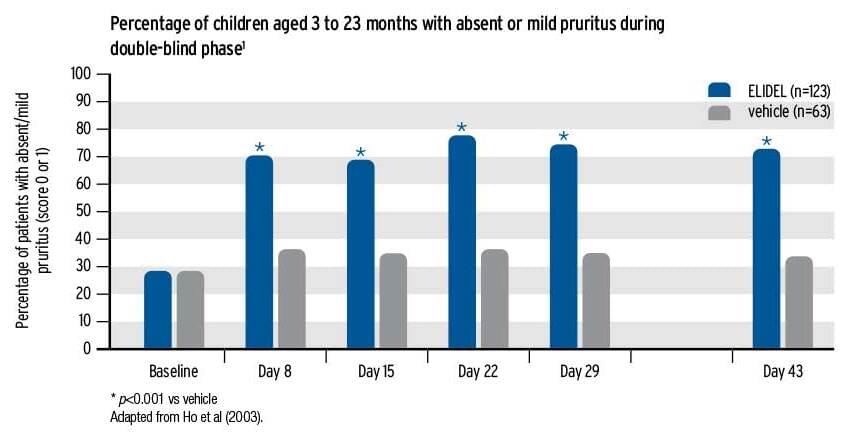
ELIDEL was demonstrated to significantly reduce ITCH versus vehicle1,2
In infants, 3 to 23 months
At Day 8, in a study in infants aged 3 to 23 months, more ELIDEL patients (69.9%) had absent or mild pruritus than vehicle treated patients (36.5%) (p<0.001) (2° endpoint).1*
In children, 2 to 18 years
More ELIDEL patients (44.2%) had mild or no pruritus at Day 8 compared to vehicle (25.7%) in two, independent, identically‑designed studies in patients aged 2 to 18 years (p<0.001; pooled data; 2° endpoint)2†
In patients 12 years and older
At 8 days, in a study in patients 12 years and older, 60.4% in the ELIDEL group had no or mild pruritus versus 33.3% in the vehicle group (p<0.001) (2° endpoint).3‡


Demonstrated IGA score of 0 or 1 (clear or almost clear) for RASHES in significantly more patients versus vehicle1,3,4
In infants, 3 to 23 months
In a study of infants aged 3 to 23 months, at 6 weeks, 54.5% of ELIDEL patients were rated as clear or almost clear versus 23.8% in vehicle-treated patients (n=186; p<0.001; 1° endpoint).1§
In children, 2 to 18 years
In two, independent, identically-designed studies in patients aged 2 to 18 years, at 6 weeks, 35% of ELIDEL patients were rated as clear or almost clear versus 18% in vehicle-treated patients (pooled data; n=403; p≤0.05; 1° endpoint).4¶
In patients 12 years and older
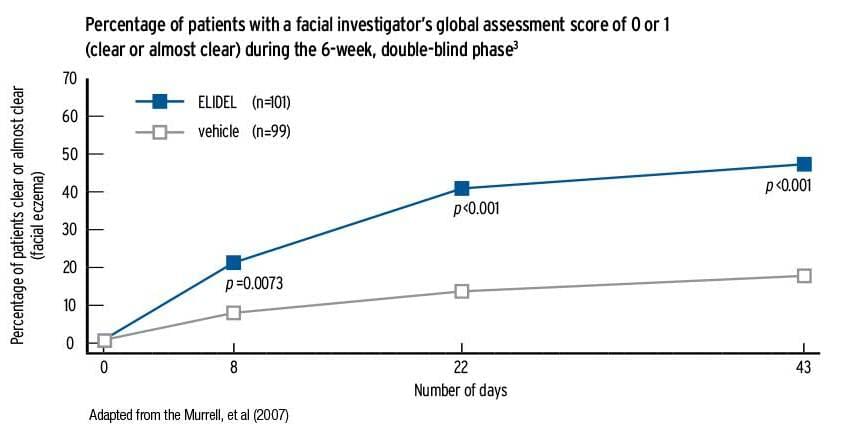
In patients 12 years and older, 46.5% of ELIDEL patients were rated as clear or almost clear of facial AD versus 16.2% in vehicle-treated patients at 6 weeks (n=200; p<0.001; 1° endpoint).3**


Treatment with ELIDEL resulted in fewer FLARES versus vehicle
Study included patients with severe AD and ELIDEL was used first-line. ELIDEL is not indicated in severe AD nor as first-line therapy.
In a double-blind, randomized, vehicle-controlled study in 711 pediatric patients aged 2–17 years with atopic dermatitis:5††
Proportion of patients without flares
The proportion who completed 6 months of treatment without any flares was substantially higher in the ELIDEL group vs the vehicle group (61% vs 35%, p<0.001, 1° endpoint).2,5

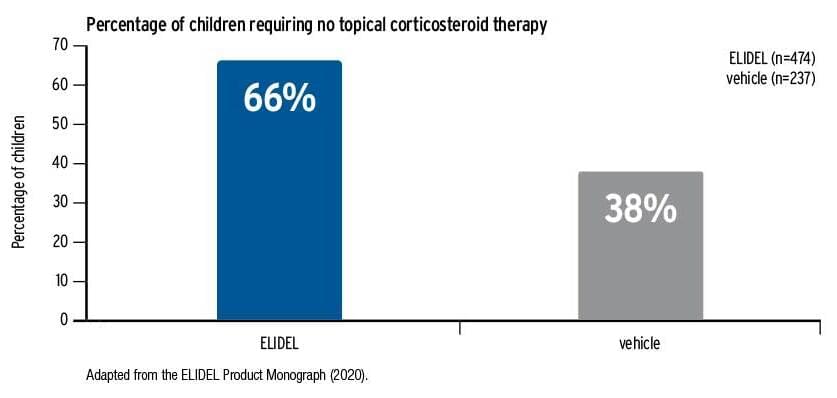
Data for required corticosteroid therapy versus vehicle2,5
Study included patients with severe AD and ELIDEL was used first-line. ELIDEL is not indicated in severe AD nor as first-line therapy.
In a double-blind, randomized, vehicle-controlled study in 711 pediatric patients aged 2–17 years with atopic dermatitis.5††
In the study, in the ELIDEL treatment group, 66% required no corticosteroid therapy compared to 38% of the vehicle patients (other endpoint).2,5††
ELIDEL has a proven safety profile2
In infants from 3 to 12 months:
In a five-year multicentre, open-label, parallel group study, 1205 patients were randomized to ELIDEL cream and 1213 patients were randomized to topical corticosteroids (TCS). The three most frequent drug-related adverse events in the ELIDEL cream group were
- lymphadenopathy (1.6%)
- application site erythema (1.4%)
- application site infection and eczema infected (1.2% each)2

- Indicated in patients 3 months and older2
-
In vehicle-controlled studies:
- Significantly reduced itch at Day 81,3,4
- Achieved IGA score of 0 or 1 (clear or almost clear) in more patients vs vehicle4
- Demonstrated significantly fewer flares5
- Has a proven safety profile2
Clinical use:
Geriatrics (>65 years of age): Clinical studies of ELIDEL did not include sufficient numbers of patients aged 65 and older to establish efficacy and safety of the drug in geriatric patients.
Contraindications:
Known or suspected hypersensitivity to pimecrolimus or any of the cream components.
Relevant warnings and precautions:
- Active cutaneous viral infections
- Clinically infected atopic dermatitis
- Varicella zoster or herpes simplex virus infection, eczema herpeticum
- Skin bacterial infections
- Lymphadenopathy
- Skin papilloma or warts
- Exposure to natural or artificial sunlight
- Malignancies, including cutaneous and other types of lymphoma and skin cancers
- Immunocompromised patients
- Ophthalmic use
- Netherton’s syndrome
- Skin burning
- Pregnant or nursing women
- Contact with nose, eyes and mouth
For more information:
Please see Product Monograph here for important information on adverse reactions, drug interactions and dosing not discussed in this piece. Product Monograph is also available by calling 1-800-361-4261.
A 6-week, double-blind, randomized, vehicle-controlled, multicentre trial in 186 patients aged between 3 and 23 months with mild to moderate AD (ELIDEL, n=123; vehicle, n=63). The intensity of overall itching/scratching in the 24 hours before a visit was assessed using values ranging from 0 (no itching/scratching) to 3 (itching/scratching that disturbs sleep).
Two identical 6-week, randomized, vehicle-controlled, multicentre, phase III trials in 403 patients 2-18 years old with mild to moderate AD (ELIDEL, n=267; vehicle, n=136). About 75% of patients had atopic dermatitis affecting the face and/or neck region. Primary efficacy endpoint: the Investigator’s Global Assessment (IGA) score. Secondary endpoints included Eczema Area and Severity Index (EASI) and severity of pruritus scores.
A randomized, double-blind, vehicle-controlled, study in 200 patients aged 12 years and older with mild to moderate head and neck atopic dermatitis (ELIDEL, n=101; vehicle, n=99). Pruritus of the head and neck was a secondary efficacy endpoint.
A 6-week, double-blind, randomized, vehicle-controlled, multicentre trial in 186 patients aged between 3 and 23 months with mild to moderate AD (ELIDEL, n=123; vehicle, n=63). The intensity of overall itching/scratching in the 24 hours before a visit was assessed using values ranging from 0 (no itching/scratching) to 3 (itching/scratching that disturbs sleep).
Based on two identical 6-week, randomized, vehicle-controlled, multicentre, phase III trials in 403 patients 2-18 years old with mild to moderate AD (ELIDEL, n=267; vehicle, n=136). About 75% of patients had atopic dermatitis affecting the face and/or neck region. Primary efficacy endpoint: the Investigator’s Global Assessment (IGA) score. Secondary endpoints included Eczema Area and Severity Index (EASI) and severity of pruritus scores.
A randomized, double-blind, vehicle-controlled, study in 200 patients aged 12 years and older with mild to moderate head and neck atopic dermatitis (ELIDEL, n=101; vehicle, n=99). Pruritus of the head and neck was a secondary efficacy endpoint.
A 1-year, double-blind, controlled study. 711 patients were randomly assigned in a 2:1 ratio to receive either a pimecrolimus cream 1% treatment regimen or a control treatment regimen, respectively. The primary endpoint was the incidence of flares in 6 months. Study population included patients with severe AD and ELIDEL was evaluated as first-line foundation therapy. ELIDEL is not indicated as first-line therapy or in severe AD.
- Ho VC, Gupta A, Kaufmann R, et al. Safety and efficacy of nonsteroid pimecrolimus cream 1% in the treatment of atopic dermatitis in infants. The Journal of Pediatrics. 2003;142(2):155–62.
- ELIDEL Product Monograph, Bausch Health Canada. January 16, 2020.
- Murrell DF, Calvieri S, Ortonne JP, et al. A randomized controlled trial of pimecrolimus cream 1% in adolescents and adults with head and neck atopic dermatitis and intolerant of, or dependent on, topical corticosteroids. Br J Dermatol. 2007;157(5):954–9.
- Eichenfield LF, Lucky AW, Boguniewiczc M, et al. Safety and efficacy of pimecrolimus (ASM 981) cream 1% in the treatment of mild and moderate atopic dermatitis in children and adolescents. Journal of the American Academy of Dermatology. 2002;46(4):495–504.
- Wahn U, Bos JD, Goodfield M, et al. Efficacy and Safety of Pimecrolimus Cream in the Long-Term Management of Atopic Dermatitis in Children. Pediatrics. 2002;110(1):e2.