Thank you for answering the Contrave quiz!
-
Canadian Adult Obesity Clinical Practice GuidelinesNaltrexone/bupropion combination is a recommended option, in conjunction with medical nutrition therapy, physical activity, and psychological interventions, for individuals with a BMI ≥30 kg/m2 or ≥27 kg/m2 with adiposity-related comorbidities.2
-
CONTRAVE has a dual-component mechanism of action*Non-clinical studies suggest that CONTRAVE has effects on the hypothalamus and the mesolimbic dopamine circuit, two separate areas of the brain involved in the regulation of food intake.1*

The exact neurochemical effects of CONTRAVE leading to weight loss are not fully understood.
-
All CONTRAVE patients have access to ExperienceContrave.ca for free- First month’s supply of CONTRAVE at no charge
- FREE enrollment to the CONTRAVE Support Program for ongoing financial assistance and motivational counselling.
-
CONTRAVE is an oral treatment option in chronic weight management, dosed at two tablets twice daily
CONTRAVE dosing should be escalated accordingly:
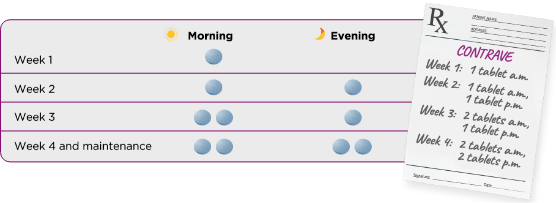
Adapted from Product Monograph1
- In order to minimize the risk of seizures, the maximum recommended daily dose should not be exceeded.
- Response to therapy should be evaluated after 12 weeks at the maintenance dosage. If a patient has not lost at least 5% of baseline body weight,
discontinue CONTRAVE, as it is unlikely that the patient will achieve and sustain clinically meaningful weight loss with continued treatment. - Dosage adjustments are required in patients with hepatic impairment (maximum dose 1 tablet in the morning in mild or moderate hepatic
impairment) or renal impairment (maximum dose 2 tablets, one in the morning and one in the evening in moderate or severe renal impairment),
and with concomitant use of CYP2B6 inhibitors (maximum dose 2 tablets, one in the morning and one in the evening). All patients with hepatic or
renal impairment should be closely monitored for possible adverse effects (e.g., insomnia, dry mouth, seizures) that could indicate high drug or
metabolite levels. - CONTRAVE should not be taken with a high-fat meal. The tablets should not be cut, chewed, or crushed.
- Blood pressure and pulse should be measured prior to starting therapy with CONTRAVE and should be monitored at regular intervals consistent
with usual clinical practice. CONTRAVE should not be given to patients with uncontrolled hypertension and should be used with caution in patients
with controlled hypertension prior to treatment.
- The effect on cardiovascular morbidity and mortality has not been established
- The safety and effectiveness in combination with other products intended for weight loss, including prescription drugs, over-the-counter drugs,
and herbal preparations, have not been established. - Geriatrics (≥65 years of age): Use with caution
- Pediatrics (<18 years of age): Not indicated
- Uncontrolled hypertension
- Seizure disorder or a history of seizures
- Use of other bupropion hydrochloride-containing products
- Current or prior diagnosis of bulimia or anorexia nervosa
- Chronic opioid or opiate agonist or partial agonists use, or acute opiate withdrawal
- Patients undergoing an abrupt discontinuation of alcohol, benzodiazepines or other sedatives and antiepileptic drugs
- Concomitant administration of monoamine oxidase inhibitors (MAOI)
- Concomitant administration of the antipsychotic thioridazine
- Pregnancy
- Severe hepatic impairment
- End-stage renal failure
- Potential association with behavioural and emotional changes, including self-harm: monitor for suicidal ideation and for agitation-type emotional and behavioural changes
- Seizures: to minimize the risk of seizures, the maximum recommended daily dose should not be exceeded
- Interference with the action of opioid-containing drug products, vulnerability to opioid overdose, and precipitated opioid withdrawal
- Increase in blood pressure and heart rate; not for use in patients with uncontrolled hypertension and caution in patients with controlled hypertension
- Dependence/tolerance
- Risk of hypoglycemia in patients with type 2 diabetes on antidiabetic therapy
- Hepatotoxicity; discontinue in the event of symptoms and/or signs of acute hepatitis
- Drugs metabolized by CYP2D6; do not use in combination with tamoxifen
- Angle-closure glaucoma
- Activation of mania and hallucinations
- Allergic reactions
- Not recommended in nursing mothers
- Closely monitor patients with hepatic and renal impairment; dose adjustments required in mild to moderate hepatic impairment and moderate or
severe renal impairment - Contains lactose
Consult the Product Monograph for important information relating to adverse reactions, drug interactions, and dosing information
which have not been discussed in this piece. The Product Monograph is also available by calling 1-800-361-4261.
* Clinical significance unknown.